


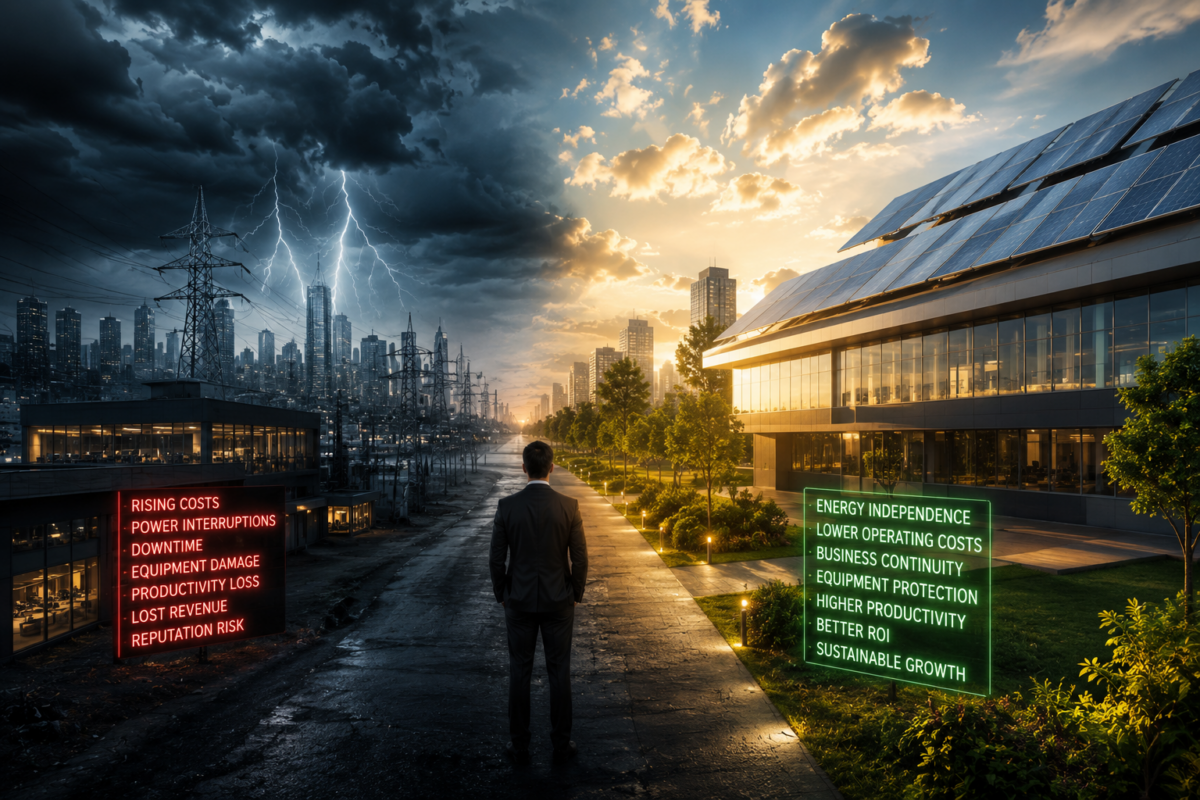
Electricity Costs Are Only Part of the Equation
When organisations evaluate their electricity bills, they usually focus on the amount they pay each month. But for many Kenyan businesses, the greatest cost of energy isn't found on the utility invoice—it's hidden within operations.
Every power interruption, voltage fluctuation, equipment shutdown, production delay, and lost hour carries a financial consequence that often goes unnoticed until it begins affecting profitability.
As Kenya's economy continues to industrialise and businesses become increasingly dependent on digital systems, manufacturing equipment, refrigeration, logistics, and automation, energy is no longer simply another utility expense.
It has become a strategic business asset.
The Hidden Cost of Downtime
For a manufacturing plant, a brief interruption can halt production, delay deliveries, and create expensive restart procedures.
For a hotel, it can affect guest experience, kitchen operations, reservations, and essential services.
For hospitals, uninterrupted power is critical to patient care.
For logistics companies, refrigeration failures can compromise valuable inventory.
For office environments, even a short outage can disrupt communications, cloud services, security systems, and employee productivity.
These indirect costs often exceed the price of the electricity itself.
Why Energy Resilience Matters More Than Ever
Modern businesses operate in an increasingly connected environment.
Cloud computing, digital payment systems, automated manufacturing, data centres, surveillance, and connected facilities all rely on continuous electrical supply.
As organisations expand, their dependence on reliable energy grows with them.
This means energy planning is no longer solely the responsibility of maintenance teams—it has become a strategic priority for executive leadership.
Businesses that invest in resilient energy infrastructure are investing in operational continuity, customer confidence, and long-term competitiveness.
Buildings Should Work Harder
Traditionally, commercial buildings have been designed to consume electricity.
Today's developments can do considerably more.
Building-Integrated Photovoltaics (BIPV) and commercial renewable energy systems enable buildings to generate clean electricity while continuing to perform their primary function.
Rather than viewing energy infrastructure as something separate from the building, organisations are increasingly integrating it directly into the property itself.
The result is infrastructure that contributes to operational performance every day.
Looking Beyond Monthly Savings
One of the most common questions organisations ask is:
"How much will solar save us?"
While reduced electricity costs are important, they represent only one part of the value equation.
Forward-looking organisations also consider:
-
Reduced exposure to rising energy costs
-
Greater operational resilience
-
Improved business continuity
-
Lower lifetime operating expenses
-
Enhanced property value
-
Stronger sustainability credentials
-
Increased investor and stakeholder confidence
These long-term benefits often outweigh immediate financial savings.
Planning Energy as Infrastructure
The most successful projects consider energy from the earliest stages of planning.
Developers integrate renewable energy into new commercial buildings.
Industrial operators evaluate energy requirements alongside production expansion.
Institutions design facilities that can continue serving communities even when external conditions become challenging.
By treating energy as infrastructure—not simply as a monthly expense—organisations create assets that remain productive for decades.
The Competitive Advantage
Businesses compete on efficiency, reliability, and customer experience.
Reliable energy supports all three.
Whether it's protecting manufacturing output, maintaining guest comfort, safeguarding critical systems, or ensuring uninterrupted service delivery, resilient energy infrastructure provides a measurable competitive advantage.
Organisations that generate part of their own electricity are not simply reducing costs.
They are strengthening the foundations upon which their businesses operate.
Building Stronger Businesses Through Smarter Energy
As Kenya's commercial landscape continues to evolve, organisations will increasingly look beyond traditional approaches to energy management.
The question is no longer whether renewable energy has a role to play in business.
The question is how quickly businesses can integrate it into their long-term strategy.
Those that view energy as infrastructure rather than overhead will be better positioned to manage costs, improve resilience, and compete in an increasingly demanding marketplace.
The future of business isn't powered by electricity alone.
It's powered by intelligent energy infrastructure.