


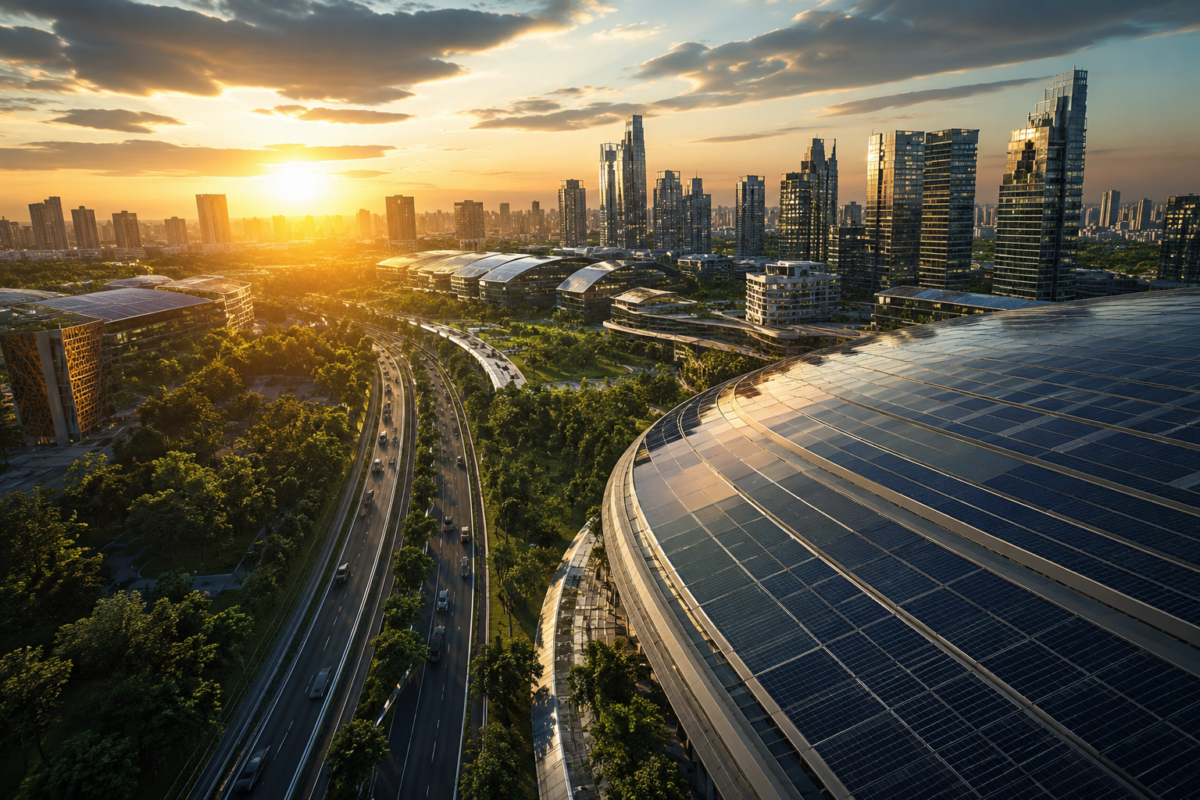
Africa's cities are growing. Their energy systems must grow differently.
Africa is urbanising at an unprecedented pace. Every year, new residential estates, commercial centres, industrial parks, hospitals, schools, airports, and transport networks are built to support expanding populations and growing economies. Yet while our skylines continue to evolve, one critical aspect of urban development has remained largely unchanged: how buildings consume energy.
For decades, buildings have been designed as passive consumers of electricity, relying almost entirely on external power grids to meet their energy needs. As electricity demand continues to rise and energy costs become increasingly unpredictable, this traditional model is becoming more difficult to sustain.
The future of urban development requires a different approach—one where buildings do more than consume power. They generate it.
That future is already taking shape through Building-Integrated Photovoltaics (BIPV).
From Energy Consumers to Energy Producers
Traditional solar installations are typically treated as an addition to a completed building. Solar panels are mounted onto existing roofs, often years after construction has finished.
Building-Integrated Photovoltaics takes a fundamentally different approach.
Instead of adding solar technology to a building, BIPV integrates energy generation directly into the building envelope itself. Roofing systems, façades, canopies, and architectural elements become productive infrastructure capable of generating clean electricity throughout the life of the building.
The result is a building that serves two essential functions simultaneously: providing shelter while producing renewable energy.
Why This Matters for African Cities
Urban centres across Africa face a unique combination of challenges.
Rapid population growth is increasing electricity demand. Commercial developments require reliable power to remain competitive. Public infrastructure must serve growing communities while operating within constrained budgets. At the same time, governments and investors are placing greater emphasis on sustainability, resilience, and environmental performance.
These pressures require more than incremental improvements.
They require infrastructure that is designed to perform differently from the outset.
By integrating renewable energy directly into buildings, developers and public agencies can reduce operational costs, strengthen energy resilience, and create infrastructure that delivers value long after construction is complete.
Infrastructure That Pays Back
Infrastructure has traditionally been viewed as a long-term capital investment. Roads move people. Bridges connect communities. Water systems deliver essential services.
Buildings should be viewed in the same way.
When integrated with BIPV, a building becomes more than a physical asset—it becomes part of the energy infrastructure supporting the people and businesses that occupy it.
Over time, this can reduce dependence on grid electricity, improve operational efficiency, and contribute to lower lifetime energy costs.
For property owners and developers, that means buildings capable of delivering value beyond their primary function.
A Smarter Approach to Property Development
Across residential, commercial, industrial, and institutional sectors, energy performance is becoming an increasingly important consideration.
Property buyers are seeking lower operating costs.
Commercial tenants are looking for resilient, energy-efficient workplaces.
Manufacturers require reliable electricity to maintain productivity.
Governments are investing in infrastructure capable of supporting long-term national development.
Developments that integrate renewable energy from the earliest stages are better positioned to meet these evolving expectations.
Building for the Next Generation
The decisions made during planning and design influence how a building performs for decades.
Integrating renewable energy after construction can provide significant benefits, but designing energy generation into the building from the beginning creates greater opportunities for architectural integration, operational efficiency, and long-term value.
This is why Building-Integrated Photovoltaics is increasingly being viewed not simply as a renewable energy technology, but as an infrastructure strategy.
As African cities continue to expand, the question is no longer whether buildings should generate energy.
The question is why they wouldn't.
The Future Is Integrated
Every generation leaves behind infrastructure that shapes the next.
Today's roads, airports, hospitals, schools, and commercial developments will continue serving communities for decades to come. Integrating renewable energy into those assets today creates stronger, more resilient cities tomorrow.
Building-Integrated Photovoltaics represents more than an evolution in solar technology. It represents a shift in how we think about buildings, infrastructure, and the future of urban development.
For Africa, that future has already begun.