


Not All Solar Systems Are Designed the Same
As more homeowners, developers, businesses, and governments invest in renewable energy, one question is becoming increasingly common:
Should I choose traditional rooftop solar panels or Building-Integrated Photovoltaics (BIPV)?
While both technologies generate clean electricity from the sun, they are designed for different purposes and deliver value in different ways.
Understanding those differences is essential when planning a new development or upgrading an existing property.
What Is Traditional Rooftop Solar?
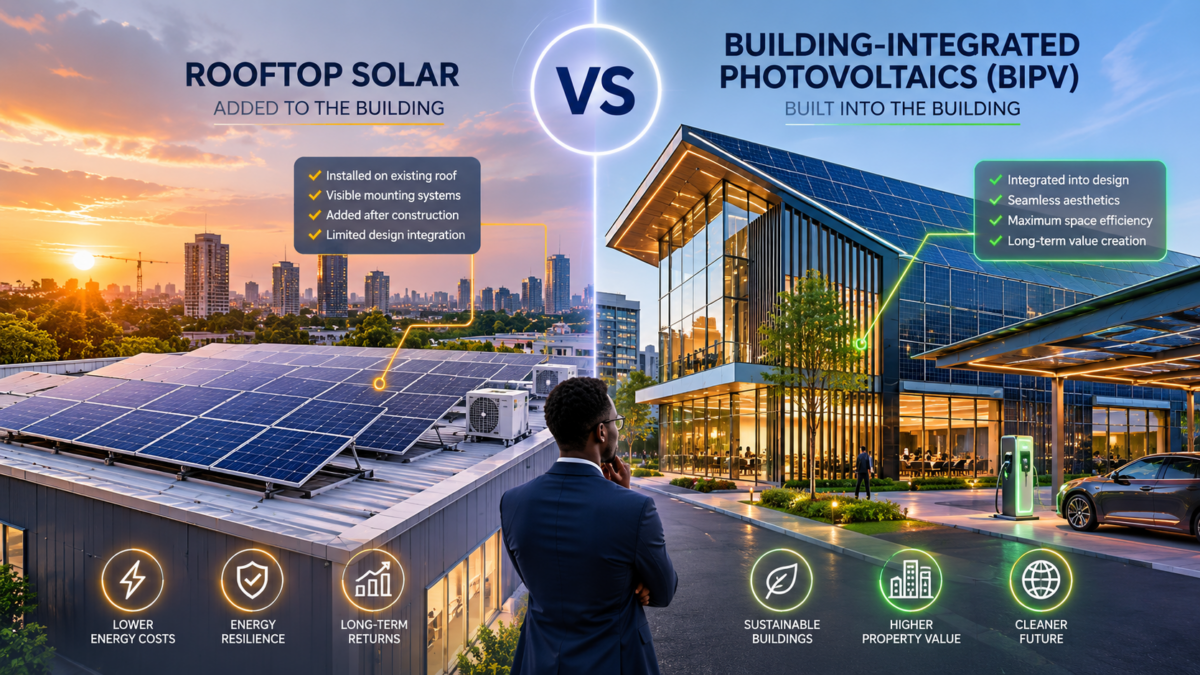
Traditional solar systems consist of photovoltaic panels mounted onto an existing roof after the building has already been constructed.
This approach has helped millions of homes and businesses generate renewable energy while reducing dependence on conventional electricity.
For many existing buildings, rooftop solar remains an effective solution because it can often be installed with minimal structural modifications.
What Is Building-Integrated Photovoltaics (BIPV)?
Building-Integrated Photovoltaics takes a different approach.
Instead of attaching solar panels to a completed building, the solar technology becomes part of the building itself.
Roofing materials, façades, skylights, canopies, and other architectural elements are designed to generate electricity while continuing to perform their primary construction function.
Rather than adding renewable energy to a building, the building is designed to produce renewable energy from the very beginning.
The Key Difference
The simplest way to understand the distinction is this:
Traditional rooftop solar is installed onto a building.
Building-Integrated Photovoltaics is built into a building.
While the difference may appear subtle, it has significant implications for design flexibility, aesthetics, long-term planning, and infrastructure performance.
Which Solution Is Better?
Neither technology is universally better.
The right solution depends on the project.
Rooftop Solar Is Often Best For:
-
Existing homes
-
Existing commercial buildings
-
Retrofit projects
-
Organisations seeking faster installation
-
Buildings with suitable roof space
BIPV Is Often Best For:
-
New developments
-
Residential estates
-
Commercial developments
-
Industrial facilities
-
Public infrastructure
-
Smart cities
-
Projects where architecture and energy are designed together
The earlier renewable energy is considered during project planning, the greater the opportunity to integrate it seamlessly into the development.
Looking Beyond Electricity Generation
Both technologies generate renewable electricity.
However, BIPV is increasingly viewed as part of the overall infrastructure strategy of a building rather than simply an energy system.
Because energy generation is incorporated directly into architectural components, developers can create buildings that contribute to long-term operational performance without treating solar as an afterthought.
For projects designed with longevity in mind, this integrated approach offers significant strategic advantages.
The Future of Property Development
Around the world, expectations for buildings are changing.
Developments are expected to be more energy-efficient.
Businesses want lower operating costs.
Governments are pursuing sustainability targets.
Investors increasingly evaluate environmental performance alongside financial returns.
These trends are encouraging developers to consider renewable energy much earlier in the design process.
As a result, Building-Integrated Photovoltaics is becoming an increasingly important part of future-ready construction.
Choosing the Right Energy Strategy
Every project has unique technical, financial, and operational requirements.
An existing warehouse may benefit from a rooftop solar installation.
A new commercial headquarters may achieve greater long-term value through integrated BIPV.
A residential estate may combine both approaches across different building types.
The objective isn't simply to install solar.
The objective is to develop the most effective long-term energy strategy for the project.
Building for Tomorrow
Renewable energy is no longer just about reducing electricity bills.
It is about creating buildings that are smarter, more resilient, and better prepared for the future.
Whether through traditional rooftop solar or Building-Integrated Photovoltaics, organisations that invest in renewable energy today are positioning themselves for greater efficiency, improved sustainability, and stronger long-term performance.
The future of energy isn't just on our buildings.
Increasingly, it's becoming part of them.